
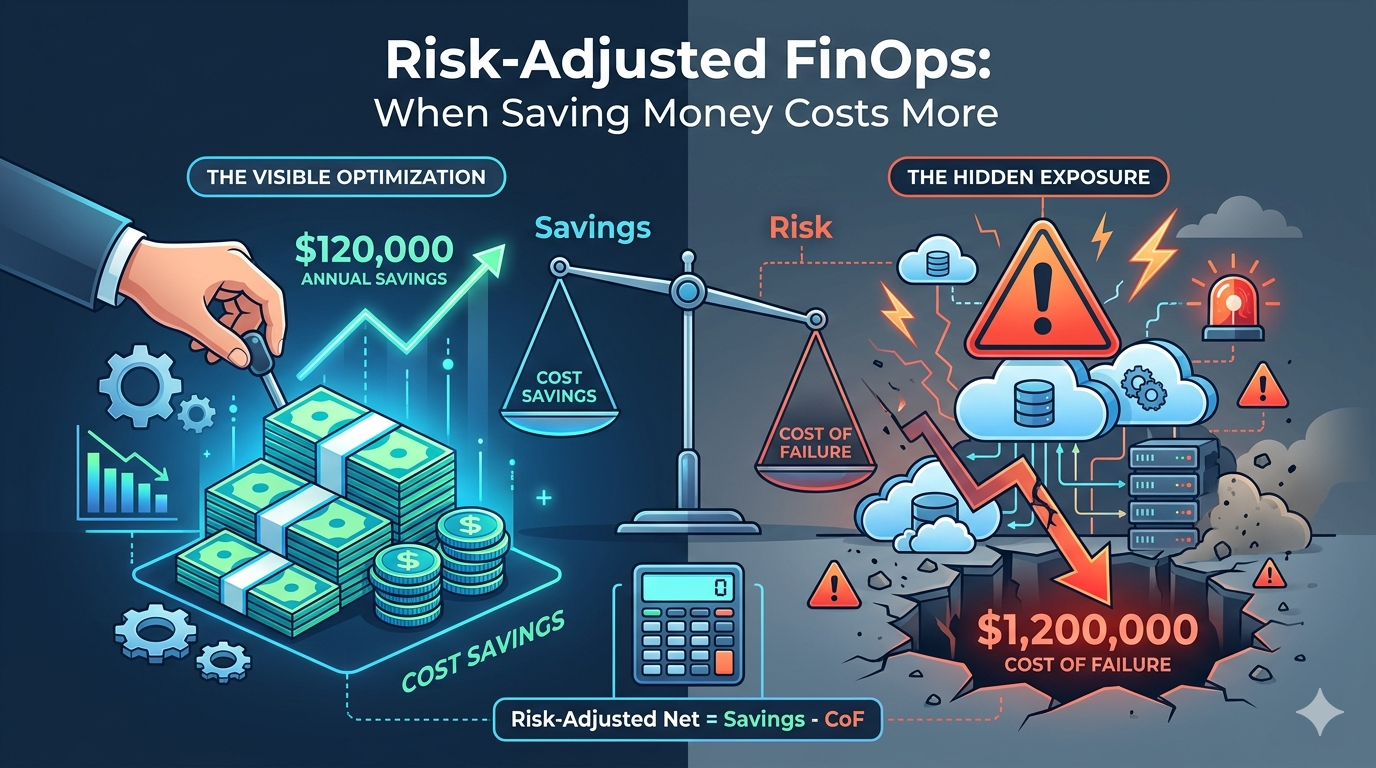
Most FinOps optimization stops at the savings number. The bill shows 12,000 dollars a month in cross-AZ data transfer, you collapse to single-AZ, and the bill shows 2,000 dollars a month. Ten thousand dollars in monthly savings, attributed back to the team that proposed it, written up in a weekly briefing. The Cost of Failure framework, formalized in the FinOps Weekly newsletter on June 7, 2026, points out that the savings number is half the calculation. The other half is the dollar value of the failure modes the optimization just introduced. Calculate both and subtract; you get the risk-adjusted net saving. Sometimes the number flips negative and the cheaper architecture turns out to be more expensive once one zone outage hits inside the annual budget cycle.
This article walks through the Cost of Failure framework, three cloud cost optimizations where the CoF reframe flips the decision (cross-AZ traffic collapse, single-region deployments, aggressive S3 lifecycle rules), and how to integrate risk-adjusted thinking into the FinOps workflow without slowing down the savings cadence. Targeted at FinOps practitioners, SRE leads, and platform engineers who own the trade-off between run-rate cost and reliability budget.
The Cost of Failure framework
The mechanical definition is straightforward. Cost of Failure equals Value per Unit multiplied by Units Affected, weighted by the annualized probability of the failure mode the optimization introduces. The output is a single dollar figure denominated in the same units as the savings estimate, which is what makes the comparison possible.
Value per Unit is whatever your business already measures as the unit economics of the affected workload. Revenue per hour for a transactional service. Cost per support ticket for a customer-facing system that escalates to humans on failure. Engineering hours lost per build pipeline outage for an internal CI system. The number should already exist somewhere in the business; the CoF calculation reuses it rather than reinventing it.
Units Affected is the count of business units that the failure mode would touch. Customers who depend on the service. Transactions per hour that flow through it. Engineers who would be blocked during a build pipeline failure. Like Value per Unit, the count should already exist in some operational dashboard.
The annualized probability weighting is where most teams underestimate the CoF. Public cloud zone outages happen at a rate of one to three events per zone per year. Regional outages happen less frequently but with much larger blast radius (the December 2024 AWS us-east-1 outage took down a meaningful share of the public internet for several hours). The numbers vary by provider and region; AWS publishes a multi-year status archive, GCP and Azure do similar. The annualized rate from those archives is the right number to use, not a vendor's quoted SLA which is an upper bound the provider commits to without committing to the historical floor.
The framework is not designed to produce a precise risk dollar figure. It is designed to make the savings and risk numbers comparable, so the relative magnitude of the trade-off becomes visible. A 50-dollar-per-month savings against a 5,000-dollar CoF floor is an obvious skip. A 5,000-dollar-per-month savings against a 500-dollar CoF floor is an obvious adopt. The mid-cases are where engineering judgment becomes the deciding factor, which is the point of surfacing the math at all.
Example 1: Cross-AZ traffic collapse
The single-AZ deployment is the canonical FinOps savings recommendation. AWS charges per gigabyte for cross-AZ data transfer at one cent per gigabyte each way (two cents round trip). A multi-AZ Kubernetes cluster with three replicas distributed across three zones will route roughly 67 percent of pod-to-pod traffic across zones by default, which on a service moving 50 terabytes of inter-pod traffic per month is around 670 dollars per month in regional data transfer alone. Collapsing to single-AZ eliminates the cross-AZ data transfer entirely. Savings on the line item is 100 percent. The recommendation looks clean.
The CoF reframe asks what the failure mode is and what it costs. The failure mode is a zone outage, which historically happens at a rate of one to three events per zone per year. The cost is the revenue per hour multiplied by the outage duration. For a service generating 5,000 dollars per hour in transactions, one zone-hour of annual downtime carries a 5,000 dollar Cost of Failure. Outage durations of multiple hours have happened on every major cloud provider in the past five years, which puts the realistic floor closer to 15,000 dollars per year per zone-event.
A single zone-event in the annual budget cycle eliminates two years of cross-AZ savings on that service. Two zone-events in the same year (which has happened in AWS us-east-1 and GCP us-central1 within recent memory) eliminate four years. The math flips negative the moment you compare like-for-like.
The recommendation that survives the CoF reframe is service-specific, not blanket. Single-AZ for stateless internal services with bounded blast radius (dev environments, staging, internal-only tools where revenue per hour is zero). Multi-AZ with K8s 1.35 trafficDistribution PreferSameZone for production services, which captures 50 to 90 percent of the same data transfer savings while preserving the zone-failover behavior. The trade-off is articulated explicitly per service rather than implied as a default across the cluster.
Example 2: Single-region deployment
Multi-region is expensive. Cross-region data transfer in AWS is two cents per gigabyte versus one cent for cross-AZ. Cross-region replication for storage doubles the storage bill. Provisioning warm capacity in a second region typically doubles the compute baseline. A 100,000-dollar-per-month service running active-active multi-region can run around 60,000 dollars per month single-region, which is a 480,000 dollar annual savings line item that is hard to ignore at year-end planning.
The CoF reframe asks the same two questions. The failure mode is a regional outage, which is rare but not unprecedented; AWS, GCP, and Azure have all had regional events in the past four years. The cost depends on the recovery time. Active-active multi-region has near-zero recovery time. Single-region with cold-DR in a second region has a four to eight hour Recovery Time Objective for most workloads. Single-region with no DR has a recovery time of "however long the provider takes to restore the region," which has been multiple hours on several historical events.
For a service generating 50,000 dollars per hour in transaction revenue with a four-hour expected outage duration, the CoF floor is 200,000 dollars per regional event. Public history puts regional events at roughly one every two to three years per major region. The annualized expected CoF is between 70,000 and 100,000 dollars per year, which is one-fifth to one-seventh of the multi-region run-rate premium.
The math for single-region is different from cross-AZ. Cross-AZ savings get eliminated by one event in the annual cycle. Single-region savings survive multiple years of normal operation but get eliminated by the rare event when it lands. Whether you make the trade depends on the business posture: the revenue at risk per hour, the SLA the business has committed to, and the regulatory floor (DORA in the EU from 2025 onward formally requires multi-region resilience for many financial services workloads, which removes the optimization from the menu regardless of CoF math).
The recommendation that survives the reframe is workload-specific. Multi-region for the customer-facing transactional plane where revenue exposure per hour is high and regulators require it. Single-region with cold-DR for internal tooling and batch workloads where the four to eight hour RTO is tolerable. Single-region with no DR for development, ephemeral environments, and explicitly-scoped failure-tolerant systems. The default of "multi-region everywhere because the SRE team said so" is as wrong as the inverted default of "single-region everywhere because the FinOps team said so."
Example 3: Aggressive S3 lifecycle rules
Lifecycle rules are the gentlest of the three optimizations. You configure S3 to expire objects after 30 days, or 90 days, or transition to a cheaper storage class after some threshold. The savings are predictable: 90 percent reduction in storage cost on Standard tier going to Glacier Deep Archive, more if you delete the object entirely after retention.
The CoF reframe is where most teams get burned because the failure mode is asymmetric. Most of the time you delete an old object and nothing happens, because nobody needed it. The CoF math says fine, the recreation cost was zero, the savings were real. But once or twice a year, the deleted object turns out to be the one piece of evidence required by an audit, a legal hold, a forensics investigation after a security incident, or a regulator request. Recreation in that case is impossible (the data has to come from somewhere it does not exist) or costs enormous engineering hours to reconstruct from secondary sources, or carries direct legal cost from missed compliance obligation.
The trick is that the asymmetric failure mode is not predictable in advance. The team configuring the lifecycle rule does not know which object will be the one that matters six months from now. The Value per Unit in the CoF calculation is not the storage cost saved, which is small. It is the legal or operational cost of not having the object when the question comes back. For audit logs the floor is typically tens of thousands of dollars per missing-log incident. For customer-uploaded content the floor is the legal exposure plus the brand cost of telling the customer their content is gone. For database backups the floor is the cost of recreating data plus the business gap between deletion and rebuild.
The recommendation that survives the reframe is granular. Aggressive lifecycle rules on artifacts whose recreation is bounded and known: build pipeline outputs, intermediate ETL data with deterministic recreation paths, application logs past their retention floor. Conservative lifecycle rules on artifacts whose recreation is unbounded or whose retention has compliance implications: audit logs, production database backups, customer-uploaded content, anything tagged in an open dispute or legal hold. The same rule applied across both buckets without distinction is where the asymmetric failure cost compounds.
Bonus pattern that protects against the asymmetric failure: lifecycle rules with a transition to Glacier Deep Archive at the long-tail retention horizon, rather than a delete. Storage cost in Glacier Deep Archive is roughly 0.00099 dollars per gigabyte per month, which is functionally free for typical retention volumes. The object stays recoverable for the rare audit case at a 12-hour retrieval window, which is acceptable for the use cases where the asymmetric failure mode lives. The savings are nearly the same as the delete path, the CoF floor is much lower.
The trade-off-visible operating model
The pattern across all three examples is the same. The savings number is easy. The Cost of Failure number is harder, because it requires modeling the blast radius and the probability of the failure mode the optimization introduces. Most FinOps tools and recommendation engines stop at the savings calculation and present the result as a flat list of dollar opportunities sorted by magnitude. The engineering team is then expected to back-calculate the CoF from context, which is the friction point where most savings recommendations either get rubber-stamped (and quietly fail months later) or get rejected wholesale (and the savings never land).
The operating model that closes the gap is risk-scoring every recommendation as a first-class field, not a footnote. Every cost-reduction opportunity should ship with two numbers side by side: the estimated savings, and the estimated failure cost. The risk score does not have to be precise; a three-tier classification (low risk, medium risk, high risk) with the underlying CoF factors broken out is enough for engineering teams to make the call quickly.
The factors that drive the risk score on cloud cost recommendations are observable from the same telemetry the recommendation engine already uses: resource utilization patterns (a resource at 2 percent CPU utilization for 30 days has a different risk profile than one at 25 percent), active network connections (a resource serving zero traffic versus one serving live customer requests), recommendation type (deleting an idle resource is different from resizing a production database is different from purchasing a multi-year commitment), dependency count (an isolated resource with no dependents is lower risk than one with seven services pointing at it), and time-to-revert (instant rollback from a snapshot is lower risk than a multi-hour migration).
The five-factor matrix collapses into a composite risk score on every recommendation. Engineering teams reading the recommendation see both numbers, can ask the CoF question without leaving the recommendation view, and can make the trade-off explicit. The FinOps team stops being the savings-finder and starts being the trade-off-clarifier, which is the role that scales.
Where this becomes operational
Brain Agents AI's Savings Advisor implements the five-factor risk scoring described above on every recommendation it produces. Resource utilization comes from the cloud provider's monitoring data, active connections come from the network telemetry, recommendation type is a categorical tag on the recommendation itself, dependency count is parsed from the resource graph, and time-to-revert is derived from the action type plus the presence of a recent snapshot. The composite score lands as a low, medium, or high tier on every recommendation card, with the underlying factors visible on click for engineers who want to interrogate the reasoning before they act.
The result is a FinOps workflow where the savings and risk numbers are side by side from the start, not back-calculated by the engineering team under deadline pressure. The CoF question becomes ambient in the conversation rather than an external check the team has to remember to apply.
Risk-adjusted FinOps is not a tooling problem first; it is a discipline problem. The discipline is to refuse to act on a savings number until the failure cost is on the table. The tooling makes the discipline easier to sustain.
If your current FinOps workflow surfaces dollar savings without surfacing the risk side, the highest-leverage change you can make this quarter is requiring every recommendation to ship with both numbers before it goes into the action queue. Whether you use a tool that does it automatically or a spreadsheet column your team fills in by hand, the math has to be visible. The savings number alone is half the calculation.