
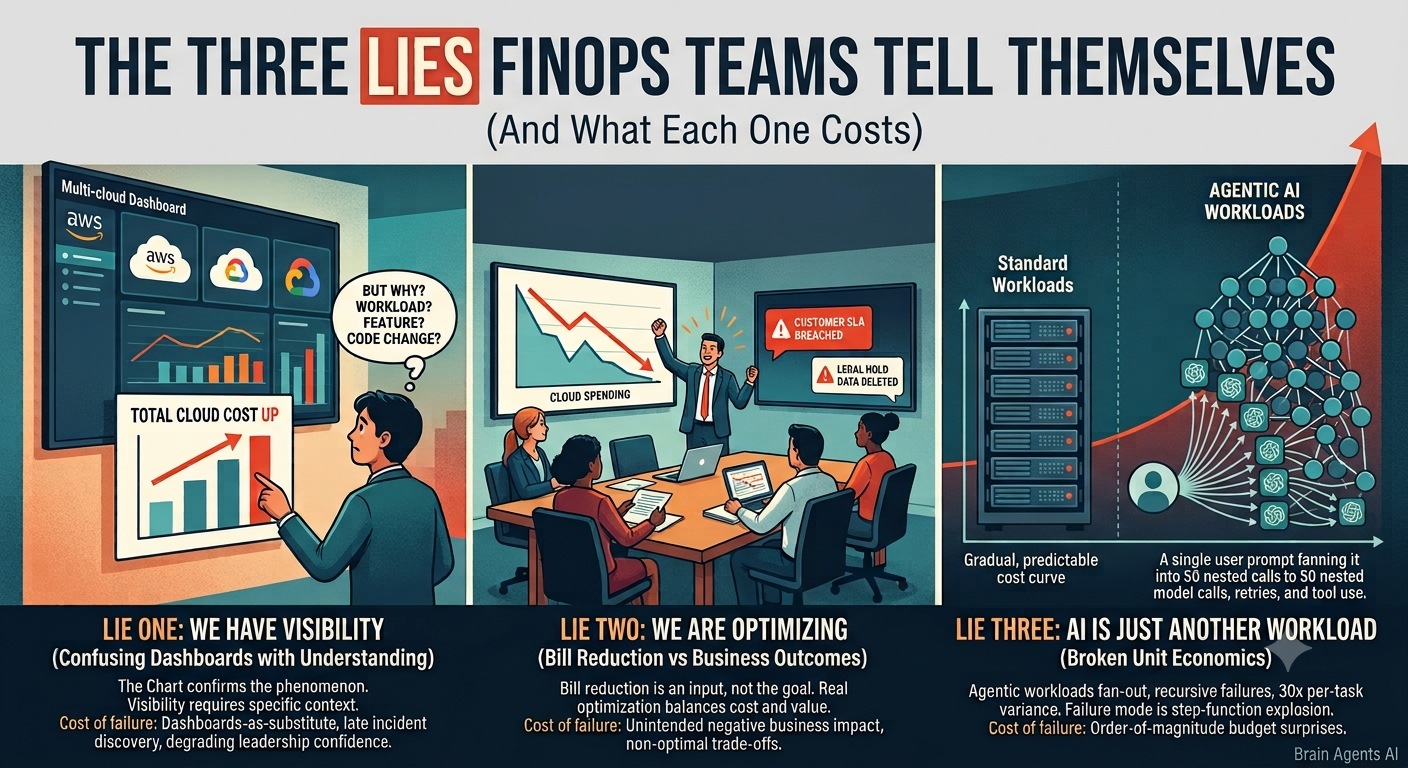
Most FinOps practice ships three structural lies forward, often without the team noticing. The first lie is "we have visibility," which usually means we have a dashboard rather than a working ability to attribute spend movements to cause. The second lie is "we are optimizing," which usually means we are cutting the bill without checking whether the business is also being cut. The third lie is "AI is just another workload," which is the lie that will hurt the most because the cost structure of agentic AI breaks three core FinOps assumptions at once. This article walks through each lie, what it actually costs the organization, what the honest answer looks like, and what tooling has to do to support the honest answer instead of papering over it.
The framing lands because every senior practitioner has seen the patterns inside their own organization. The dashboards-as-substitute-for-visibility trap is so common that most FinOps maturity assessments accidentally reward it. The bill-reduction-as-virtue reflex is so reflexive that the Cost of Failure side of the trade gets pushback the first three times you raise it. And the AI workload assumption that lifecycle policies and tags will eventually catch up is so industrially conventional that the cases of single-Wednesday agent spend growing from roughly a quarter-million dollars to nearly half a million in a month read as aberrations rather than the structural pattern they actually are.
Lie one: we have visibility
The visibility lie is the easiest to dispel and the most embarrassing once you see it. The pattern is that a senior finance partner asks a question (why did the bill spike last month, why does this team cost more than that team, what would happen to next quarter if we cut spend by 15 percent) and the FinOps team produces a chart that confirms the existence of the underlying phenomenon without explaining it. The chart is artifact-of-visibility, not visibility itself.
Real visibility is the ability to attribute a cost movement to a cause. A spike from 800 thousand dollars to 1.2 million dollars in a single month is not "the bill went up." Real visibility says which workload caused it (the new ML pipeline rollout), which team owns the workload (the recommendations team), which feature is driving it (the model retraining cadence), and whether the movement is investment (we expected this; the workload will produce revenue at greater than 2x the spend within 90 days) or waste (a bug, a misconfiguration, an orphaned resource). Most FinOps tooling stops at the chart because the data needed to answer the question is not in a single queryable place. The cloud billing exports are in one system. The deployment metadata is in another. The team and feature tags are in a third, and were probably set inconsistently when the workloads were originally provisioned.
The cost of the visibility lie is that organizational confidence in FinOps degrades over time. The finance partner who asked the question the first time stops asking. The next time a major cost surprise lands, the FinOps team finds out about it from finance, not the other way around. The discipline drifts from a leading indicator (prevents surprises) to a lagging indicator (explains surprises after the fact), which is the exact failure mode it exists to prevent.
The path out is structural. The substrate question is whether your billing data is FOCUS-normalized and queryable across all your clouds. FOCUS (the FinOps Open Cost and Usage Specification) is the cross-cloud schema that produces a single shape for what would otherwise be three different vendor formats. Without it, every cross-cloud question requires manual translation. With it, the discovery layer (a query interface, an AI agent, a notebook) can answer the question directly against the substrate without going through the FinOps team. The dashboards become drill-down tools for the answers the substrate has already produced, not the first-line discovery tool that everyone confuses them for.
The organizational shift that goes with the substrate shift is that the FinOps team stops being the bottleneck on every cost question. The substrate plus the query interface lets engineering teams, finance teams, and leadership teams answer their own questions, with the FinOps team specializing in the questions that require domain expertise the substrate cannot answer alone (commitment portfolio strategy, contract negotiation, multi-year architectural decisions).
Lie two: we are optimizing
The optimization lie is one layer deeper than the visibility lie and structurally harder to dispel because the metric that drives the lie (the bill went down month over month) is real, measurable, and treated as a virtue by leadership. The trap is that bill reduction is not the same as business optimization. The two can move in opposite directions, and FinOps practice as it is commonly taught does not require the practitioner to check.
The Cost of Failure framework is the discipline that closes the gap. The Cost of Failure framing says that every cost reduction has an exposure side. A spend cut that breaks the ability to serve a customer SLA has a failure cost (lost revenue, contract penalty, churn). A commitment discount that locks the company into capacity it will outgrow in six months has a failure cost (forced renegotiation, lost flexibility, opportunity cost of capital). A lifecycle policy that deletes data the legal team needs for an active investigation has a failure cost (regulatory exposure, discovery costs, settlement risk). The honest optimization is the cost reduction minus the expected failure cost, integrated across the population of decisions, not the cost reduction in isolation.
The cost of the optimization lie is that the bill goes down on the FinOps scorecard while the business pays the bill in other line items the FinOps scorecard does not measure. A 60 thousand dollar per year savings from going single-AZ on the EKS deployment shows up as a win. The 180 thousand dollar per year risk exposure from the increased blast radius if that single AZ has an incident does not show up as a debit. Net business optimization is the savings minus the exposure. The FinOps practice that runs without the second column is structurally optimizing one ledger while creating debits on another.
The honest practice is to add the Cost of Failure column to every recommendation that exits the FinOps team. The column does not have to be precise. A rough order-of-magnitude failure cost (estimated value of the workload, multiplied by the probability of failure, multiplied by the recovery time expected) is enough to flip the recommendation from "save 60K" to "save 60K with 180K exposure" and let the recipient make the trade with both numbers visible. The reflex of FinOps tooling to surface only the cost side is so deep that this addition feels foreign the first dozen times you do it. The reflex of leadership to want both numbers, however, is much faster than the tooling assumes; finance leaders are familiar with two-sided decisions and are happy to receive them.
The deeper organizational shift is that optimization decisions stop being unilateral FinOps recommendations and start being collaborative trade-off conversations. The FinOps team is the structurally best-positioned function to compute the cost side. The risk team or the engineering team is the structurally best-positioned function to compute the failure side. The honest practice is the join, not either side in isolation.
Lie three: AI is just another workload
The AI workload lie is the one that will hurt the most. The reason is that AI workloads break three assumptions the FinOps cost model relies on, simultaneously, in production. The assumptions are: cost attributes to a resource, cost varies smoothly with usage, and cost failures are gradual creeps rather than step-function explosions.
The unit-of-attribution assumption fails first. In cloud FinOps, the unit of cost is the resource (a VM, a container, a storage bucket, a database instance). Tagging the resource with a team, a feature, and an environment is the standard discipline. In agentic AI, the unit of cost is the request, and the request can fan out into 50 model calls inside a single user action. The team that owns the user action is one team. The team that owns the agent runtime is another. The team that owns the model gateway is a third. The cost of the action belongs to multiple teams simultaneously in a way that cloud resources do not. Tagging the resource is necessary but not sufficient; the request-level attribution chain has to be reconstructed from the model gateway logs or the proxy headers, and most teams do not have that instrumentation in place when the bill first surprises them.
The smooth-cost-variance assumption fails second. In cloud FinOps, the cost of running a workload twice is approximately twice the cost of running it once. The variance is bounded. In agentic AI, the variance per equivalent task is roughly 30x in observed production data. The same user request against the same model can produce a 10-cent answer or a 3-dollar answer depending on how much context the agent decided to retrieve, how many tool calls the agent chained, how many retries the model burned on a transient failure, and whether the user happened to phrase the question in a way that triggered a deep-reasoning fallback. The forecasting models that work for cloud workloads (linear regression on usage, lightly seasonally adjusted) produce nonsense projections when applied to agentic workloads because the variance is structural, not noise.
The gradual-creep assumption fails third, and this is the failure mode that produces the headline incidents. Publicly discussed enterprise rollouts of agentic coding assistants have grown from roughly 250 thousand dollars per Wednesday to roughly 400 thousand dollars per Wednesday over four weeks. Earlier industry incidents in early 2026 described 40 thousand dollar burns over 30 days on uncontrolled agent loops with no per-agent budget limits and no per-cycle observability. These are not Black Swan events. They are the failure mode of the workload class, repeating across multiple named industry cases in a single quarter because the underlying conditions (no per-request budget enforcement, no per-cycle observability, no per-agent attribution, no automated kill switch on cost runaway) are industrially common.
A useful framing for AI spend is the iceberg model. Above the waterline (what finance sees today) sits the AI provider invoice and the token usage report. Below the waterline (what finance does not see) sit the retry storms when an agent loops on a failed tool call, the agentic chains where one user prompt expands into 5 to 20 model calls, the model sprawl where teams adopt new models without retiring old ones, and the GPU reservations made just in case that mirror the idle-VM problem at the AI infrastructure tier. The visible surface is roughly 20 percent of the cost picture in mature agentic deployments. The invisible 80 percent only becomes visible after an incident, which is the wrong order of operations for a discipline that exists to prevent incidents.
The cost of the AI workload lie is that the FinOps practice spends 18 months extrapolating cloud cost mental models onto the AI workload, watches the bill grow at a rate the dashboards do not flag because the dashboards were calibrated against cloud variance, and finds out about the structural problem from a finance leader who got the quarterly variance report rather than from a leading indicator inside the FinOps function. The 18-month delay is the cost. The emerging discipline that handles this workload class correctly is what the industry has started calling Tokenomics.
Tokenomics is FinOps for the era when the unit of cost is the request, the unit of attribution is the workflow, and the failure mode is the step function. The discipline is not built yet at the practitioner level (most FinOps teams are still in the early visibility-and-attribution phase for AI), but the standards-body work has started, the FOCUS extensions to handle AI workload attribution are in progress, and the terminology is consolidating. The teams that get ahead of the curve will be the teams that recognize the AI workload lie early and treat AI workload attribution as a separate practice from cloud resource attribution from day one, rather than retrofitting it after the first 250-thousand-dollar Wednesday.
What honest practice looks like
Across the three lies, honest FinOps practice has three operational shifts.
The first shift is that dashboards become drill-down tools rather than discovery tools. The discovery layer is an agent, a query interface, or a notebook that operates on FOCUS-normalized billing data across all connected clouds. The dashboards exist to render the answers the substrate has already produced, not to be the first-line interface to the data. The teams that confuse the two end up with prettier dashboards and the same blind spots.
The second shift is that optimization recommendations carry a Cost of Failure column. The exact failure-cost estimate does not need to be precise; an order-of-magnitude rough number is enough to flip the recommendation from a unilateral instruction to a two-sided trade. The leadership reflex to want both numbers is much faster than tooling assumes.
The third shift is that AI workload attribution gets its own practice, separate from cloud resource attribution. The unit is the request. The join key is a business-context tag set at the workflow boundary. The alerting cadence is sub-daily because the failure mode is the step function. The FOCUS substrate handles the cloud-resource side; an AI-specific attribution layer (proxy headers, request-level instrumentation, per-agent tagging) handles the request side. Most teams that have not done this work yet are running on borrowed time against the next Wednesday-going-from-250K-to-400K event.
The tooling implication is that the substrate question (do you have FOCUS-normalized billing data across your clouds, queryable in real time) is more load-bearing than it looks. Without it, every honest answer to a finance question requires a manual translation step. With it, the three lies become much harder to tell yourself because the data refuses to support them.
Where Brain Agents AI sits
Brain Agents AI is an AI-powered FinOps platform that operates on FOCUS-normalized billing data. Today we support GCP and AWS in beta; Azure is on the roadmap. The four agents are Cost Scout (anomaly detection on the billing data), Savings Advisor (recommendations with risk scoring), AI Cost Analyst (ad-hoc questions in natural language), and Weekly Briefing (executive-level summary with the changes that mattered).
The product is designed to compress the gap between a finance question and an honest answer, which is the gap each of the three lies opens. We work at the bill layer rather than the call path, which is the architectural posture that lets us cover the cloud-resource attribution side cleanly without requiring any code change in the customer's production environment. We do not do real-time event detection (post-beta roadmap), we do not do auto-remediation (post-beta roadmap), and we do not yet provide request-level AI attribution (the proxy-layer instrumentation that would be needed for the Lie 3 surface is a separate product class). What we do give you is the FOCUS-normalized substrate, the question-answer interface, and the recommendations with cost-and-benefit framing that make the kind of honest accounting the three-lies framework demands possible at the substrate layer.
The three lies are organizational habits more than they are tooling gaps. The right tooling makes them harder to maintain; the wrong tooling makes them easier. The decision the framework forces on FinOps teams is whether to keep doing the practice as it has been taught for a decade or to confront the patterns the three lies name and rebuild the discipline around honest answers. The teams that pick the second path get to skip the 18 months of accidentally-running-the-old-mental-models against the new workload class. The teams that pick the first path get to confront the lies the next time finance asks a question the dashboard cannot answer.