
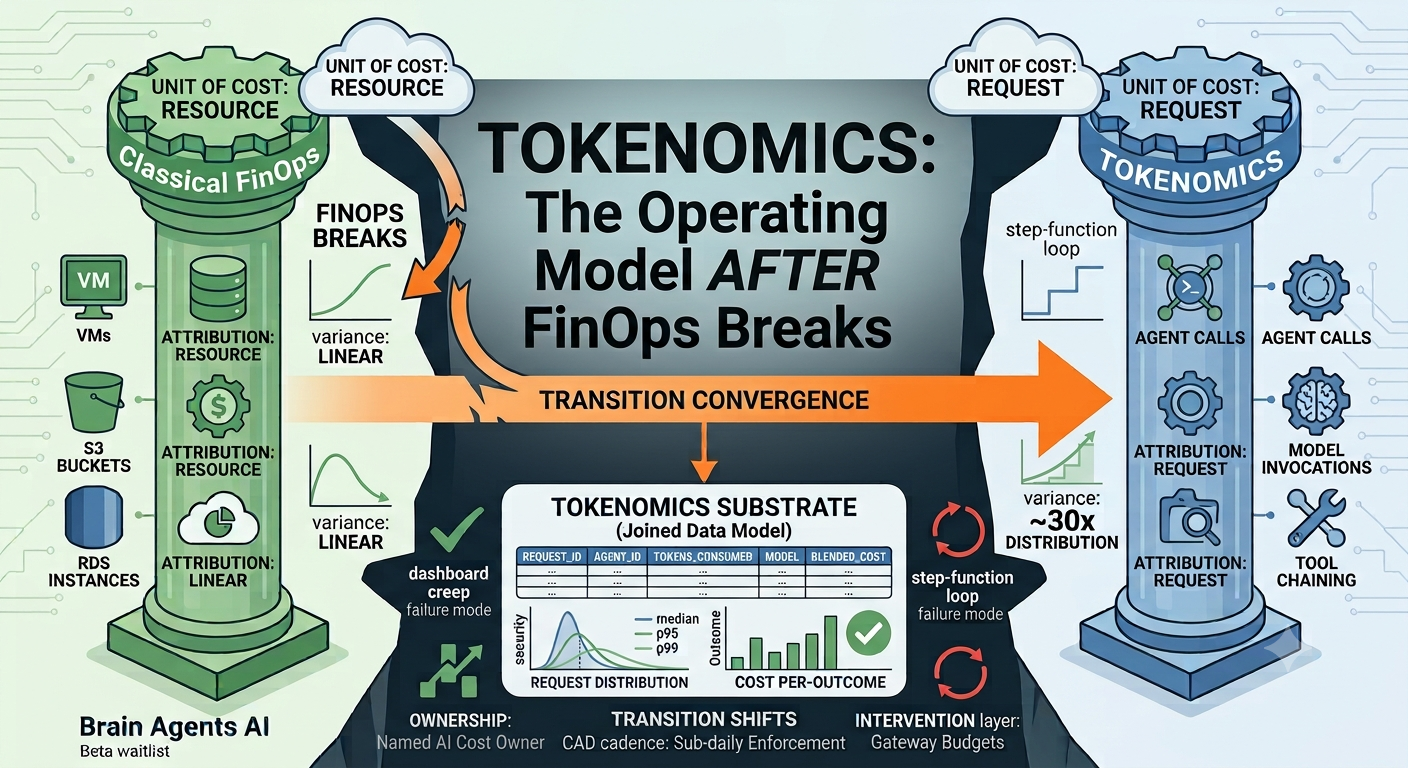
FinOps breaks under agentic AI workload economics because three assumptions the discipline was built on stop holding at once. Tokenomics is the operating model that takes over. This article walks through which assumptions break, what Tokenomics adds on top of classical FinOps, what the substrate looks like, and what the transition costs an organization to execute well. The answer, front-loaded so you can decide whether to keep reading, is that Tokenomics is not a new tax. It is a new discipline for a different cost structure. The unit of cost is the request, not the resource. The variance is thirty times per equivalent task, not linear with usage. The failure mode is a step function that unfolds over hours, not a gradual creep visible on a monthly dashboard. Teams that treat AI workload cost as another line item on the classical FinOps ledger get the magnitude of surprises wrong by an order of magnitude. Teams that add the Tokenomics layer alongside the FinOps layer keep pace with the workload class.
The framing is important because the reflexive response to the phrase "AI cost is different" is to reject it as marketing. The rejection is not unreasonable. Every new technology category claims to be structurally different from the ones it succeeded, and most of those claims turn out to be marketing. The claim about AI workload cost is different because it is not a claim about marketing, it is a claim about which specific FinOps assumptions break under which specific workload patterns. This article makes those specific claims. If any of them turn out to be wrong for a specific organization's actual workload profile, that organization does not need a Tokenomics practice yet and should get on with classical FinOps instead. If all of them ring true, the reason is that the workload class has moved past the range that classical FinOps was designed to handle, and adding the Tokenomics layer is not optional.
The three assumptions that break
Classical FinOps rests on three assumptions that quietly do most of the work behind the discipline. When any single one of them holds, the practice runs fine. When all three break at once, the practice does not just miss a few edge cases. It loses the ability to answer the questions leadership relies on it to answer.
The unit-of-cost assumption. In classical FinOps the atom of cost is the resource. A virtual machine, a container, a storage bucket, a database instance, a queue. Tagging the resource with a team, a feature, and an environment gives the practice its attribution model. The resource is stable. The tags are stable. The cost is stable. Reporting is arithmetic on top of this base.
In agentic AI the atom of cost is the request. A single user asks a question. The agent decides to consult five tools in a row. Each tool call routes through an MCP server. Each server invokes the model to synthesize the tool response. Fifty model calls belong to one user action, and those fifty calls may be spread across several agent runtimes owned by several teams. Tagging the resource, in the classical sense, gives you infrastructure attribution. It does not give you the per-request cost that the practice actually needs. The tokenomic attribution model has to be built at the request level and it has to be built from scratch because classical FinOps tools do not carry a native concept of a request.
The cost-variance assumption. Classical FinOps forecasting assumes that the cost of running a workload twice is approximately twice the cost of running it once. This assumption enables monthly forecasting, commitment sizing, and unit economics on the same time horizon. The forecasting models used across the discipline are all linear or lightly seasonal regressions on top of usage curves, which are the right shape when the variance is bounded.
In agentic AI the cost per equivalent task varies by roughly thirty times in observed production data. The same request against the same model can produce a ten-cent answer or a three-dollar answer depending on how much context the agent decided to retrieve, how many tool calls the chain expanded to, how many retries the model burned on a transient failure, and whether the user happened to phrase the question in a way that triggered a deep-reasoning fallback. Linear regression on top of that variance produces projections that are technically correct on the mean and wildly wrong on the tails, and the tails are where the cost surprises live. Forecasting for agentic workloads requires a distribution model, not a point estimate.
The failure-mode assumption. Classical FinOps expects failures to look like gradual creeps. A commitment expires and the workload rolls to on-demand rates. A team scales a service and forgets to schedule it back down over the weekend. A lifecycle policy is misconfigured and storage grows for a quarter before someone notices. All three failure modes are visible on a well-instrumented dashboard within a week of onset because they trace linear curves.
In agentic AI the failure mode is a step function. A loop starts at nine in the morning and by three in the afternoon has burned two thousand dollars, and none of it is visible on the billing dashboard because the billing pipeline is batched. The dashboard update tomorrow catches yesterday's damage; today's damage runs invisible for another twenty-four hours. A single loop pattern that repeats across sessions can consume the entire monthly budget for the AI workload category in a week. Dashboards calibrated on smooth curves do not fire on the step function until well after the damage is done, and the incident postmortem that follows is where organizations first learn that classical FinOps instrumentation was not sitting at the right level.
What Tokenomics adds
Tokenomics adds three things on top of classical FinOps, and the three things line up one-to-one with the three broken assumptions.
For the unit-of-cost break, Tokenomics adds a request-level attribution model. Every model call and every tool invocation carries a request identifier propagated through the whole chain. Cost aggregates by request rather than by resource. Per-request cost, per-user cost, per-feature cost, and per-outcome cost are all queryable from the same substrate. Classical FinOps continues to answer per-workload and per-team questions on the infrastructure side. Tokenomics answers per-request and per-outcome questions on the AI side. The two live side by side.
For the cost-variance break, Tokenomics adds a distribution-based reporting model. Instead of a single number for cost per request, the reporting surfaces the median, the p95, and the p99 as separate values. Forecasts sample from the observed distribution rather than fitting a linear model to the mean. Anomaly detection watches the distribution shape rather than the aggregate total, because a shift in the p95 is a leading indicator that the aggregate has not caught up to yet. This reporting model reads strangely to teams whose FinOps instincts were trained on smooth curves, and adjusting to reading distributions is part of the transition cost.
For the failure-mode break, Tokenomics adds a request-level control layer. Per-agent budgets enforced at the model gateway. Per-cycle limits on tool calls and tokens inside each invocation. Independent cost telemetry that does not rely on the batched billing pipeline. These controls sit in front of the workload rather than behind it. Classical FinOps controls, which live downstream of the workload in the billing pipeline, remain valuable for the infrastructure category. They do not stop step-function failures on the AI side because they run on the wrong side of the timing gap.
The three additions together are the operating model that Tokenomics names. None of them is exotic. All of them require engineering work that a competent team can execute in a quarter or two. The gating factor tends to be organizational rather than technical: getting agreement on what to measure, who owns the measurement, and where the intervention layer sits.
The substrate
Tokenomics runs on the same FOCUS-normalized billing substrate that classical FinOps runs on. Every cloud resource that carries AI workload traffic still bills through the standard billing pipeline. The tokens the AI provider charges also show up on the bill, either directly or through marketplace intermediaries. The billing substrate is table stakes for both disciplines.
On top of the billing substrate, Tokenomics adds three signal streams that classical FinOps does not require.
A request stream. Every AI call carries a request identifier. The stream logs the identifier, the timestamp, the model, the token counts, and the workload context. The stream lands in a store queryable within minutes rather than hours. This stream is the foundation of per-request attribution.
An agent stream. Every AI call also carries an agent identifier. The stream logs the identifier, the agent runtime, the tool called (if any), and the auth context under which the call executed. This stream is the foundation of per-agent attribution.
A workflow stream. Every request carries a workflow identifier that connects the request to the business outcome it supports. The stream logs the outcome, the value contribution, and the outcome-level metadata. This stream is the foundation of unit economics for AI workloads and it is the hardest of the three to instrument because it requires product-side design decisions that are not purely infrastructure.
The compound data model that joins the billing substrate to the three signal streams is what makes cost per request, cost per agent, cost per outcome, and blended unit economics computable in the same query surface. Any Tokenomics practice worth the label lives on top of that compound data model. Any practice that skips one of the three streams is a partial practice that will hit specific limits when its answers get challenged.
The transition cost
The transition to a Tokenomics practice has three parts, and each part has an organizational cost that tends to be underestimated at the planning stage.
Instrumentation cost. Propagating the request, agent, and workflow identifiers through the whole chain requires touching every agent runtime, every gateway, every MCP server, and every logging pipeline. The individual changes are small. The coordination across teams is the actual cost, especially when the runtimes were built by different teams with different conventions.
Reporting cost. Adding distribution-based reporting to the FinOps team means either extending existing tools or adding new views alongside them. The reporting has to be legible to finance and to engineering both, which is a design constraint that gets harder as the distributions get more counterintuitive. Training the audience to read p95 and p99 rather than mean is part of the reporting rollout.
Control cost. Standing up the per-agent budget layer, the per-cycle limit layer, and the independent cost telemetry layer is engineering work. The work is bounded and well-defined, but it competes with feature work for the same engineering time. Organizations that have already had an AI cost incident tend to find the trade-off easy to make. Organizations that have not yet had an incident tend to defer the work until they do.
The three costs together add up to a project that is roughly one to two quarters of concentrated engineering plus the ongoing operational cost of running the new discipline. The return on the investment is legibility of the AI workload cost story, defensibility of the AI workload budget against leadership questions, and the ability to catch step-function failures within the same day rather than in the next month's close. Whether the investment is worth it depends on how much AI workload traffic the organization runs, how variable that traffic is, and how sensitive leadership is to cost surprises in the category. The math is straightforward once the specific numbers are on the table.
Readiness
An organization is ready for a Tokenomics practice when three signals together are present. Fewer than two of the three signals means the practice is premature and the effort should go into either the FinOps substrate or the workload experimentation instead. Two of the three signals is enough to start. All three signals means the practice is overdue.
The scale signal. A materially large fraction of the AI workload budget is production traffic, not experimentation. If the budget is still mostly R and D, the failure mode of a step-function incident is bounded by the experimental scope, and the FinOps instincts trained on classical workloads are still adequate for the size of the exposure. Wait for production to dominate before adding the discipline.
The variance signal. Someone in the organization can produce the p95 and p99 cost per request off the top of their head, and the distribution has visibly widened over the last two quarters. If nobody can produce those numbers, the substrate for Tokenomics is not in place yet and the first project is instrumentation rather than practice.
The incident signal. The organization has had at least one cost incident where an agent workload consumed materially more of the budget than planned within a single billing cycle. This signal is uncomfortable to have to require, but the pattern across mature Tokenomics practices is that the discipline gets stood up in the aftermath of the first incident, not in advance of it. Organizations that manage to stand up the practice before the first incident tend to be those where the leadership has read enough industry writing on the workload class to be persuaded on the abstract case.
Two of the three signals is a green light to start. Three of the three signals is a green light to accelerate.
Where this fits Brain Agents AI
Brain Agents AI is building multi-cloud AI cost intelligence for teams running production workloads across GCP and AWS. Join the beta waitlist for early access.