
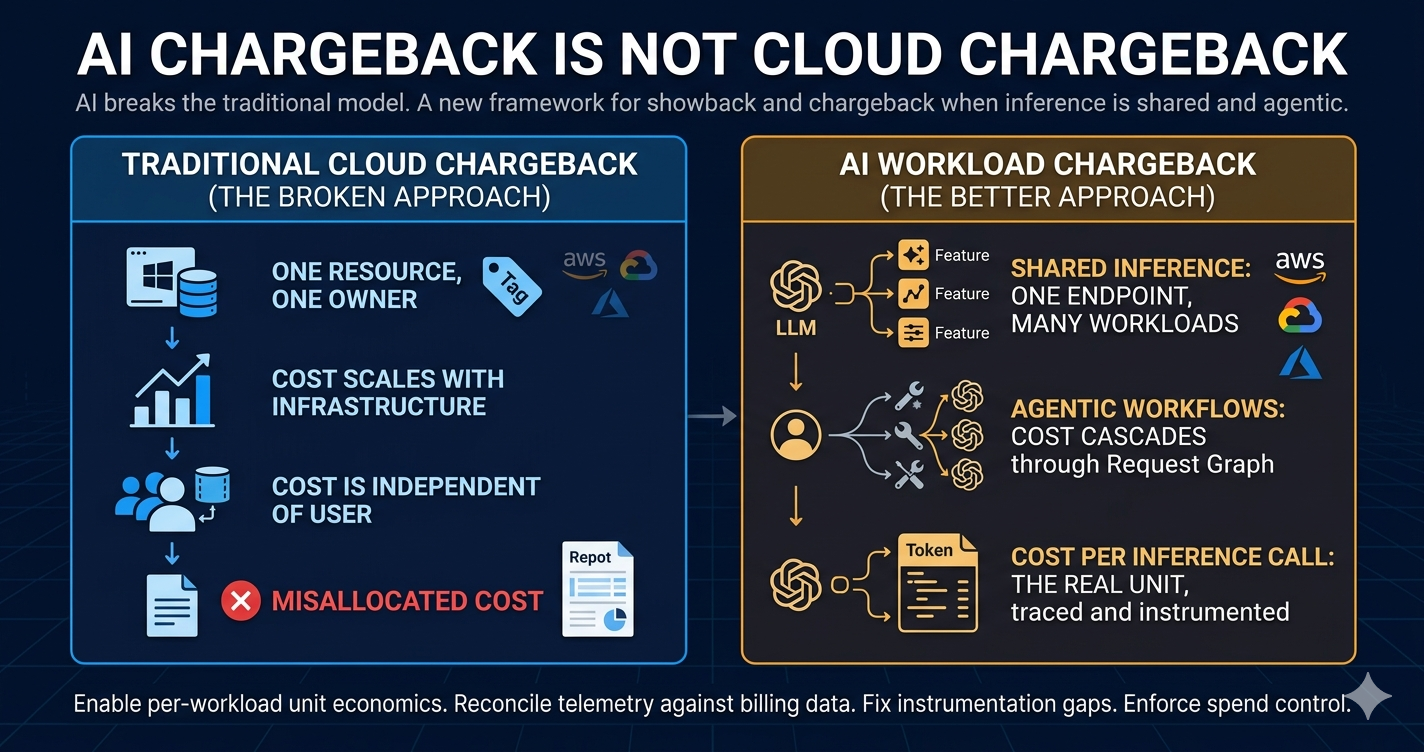
Forrester argues that the AI ROI gap is a measurement problem, not a technology problem. Ninety-seven percent of executives recognize AI's strategic value. Five percent are realizing it. Eighty-five percent say they have a solid data strategy. Less than twenty percent can govern it well enough to act on it. The will exists. The measurement infrastructure does not.
Chargeback is the measurement layer. If you cannot attribute AI spend to the workload, the customer, or the feature it serves, you cannot measure return per workload, per customer, or per feature. The 97-to-5 gap stays open at the company level because the measurement layer stays broken at the request level.
Cloud chargeback used to be a solved problem. Tag every resource with a team, environment, and product. Sum by tag. Send the report. Done.
AI workloads break that model in ways most FinOps practitioners are still discovering. A single LLM endpoint serves 50 product features. An agentic workflow triggers 12 model calls per user request. Inference is shared by design and per-request cost depends on prompt content, not infrastructure. If you apply traditional chargeback to AI, you misallocate cost in three different ways at the same time.
This article covers why AI chargeback fails when treated as a tagging problem, why even the latest cloud-provider attribution features don't close the gap, what the commitment side of the problem looks like, and the alternative framework based on cost per logical workload traced through the request graph. Targeted at ML platform engineers and FinOps leads building chargeback for AI workloads on AWS, GCP, or Azure. If you've already read our Tracking AI and ML Costs Across Clouds guide, this article picks up where the labeling section left off.
Why Cloud Chargeback Worked (And Why That Era Is Ending)
The traditional chargeback model rests on three assumptions that hold for virtual machines, databases, and storage:
- One resource, one owner. An EC2 instance, an RDS database, an S3 bucket has a clear owning team. Tag it, attribute the cost.
- Cost scales with infrastructure. A bigger instance costs more. A larger database costs more. The cost equation is governed by the resource configuration.
- Cost is independent of the user. The instance costs the same per hour whether one customer or one hundred customers access it. Per-customer attribution comes from utilization metrics, not from the bill.
AI workloads violate all three. A single Bedrock endpoint serves a customer support chatbot, an internal knowledge tool, an automated data extraction pipeline, and three experimental features. The infrastructure is one endpoint with one tag. The actual cost is split across six distinct workloads, each with its own unit economics. No amount of tagging hygiene gets you to the right answer because the tag is on the wrong object.
What Just Shipped: IAM Principal-Based Cost Allocation (And What It Still Doesn't Solve)
AWS shipped IAM Principal-Based Cost Allocation for Bedrock in April 2026. Every Bedrock API call now writes the calling IAM identity into the Cost and Usage Report (CUR 2.0). IAM tags propagate through. Cost Explorer can filter and group by IAM user, role, or tag (department, cost center, project). For the first time, an AWS-native feature attributes Bedrock spend below the service line without requiring per-feature deployment isolation.
This is the new baseline. Any AI chargeback discussion from this point forward has to start from "you have per-IAM-role attribution out of the box" rather than "you have a service-level total split by infrastructure tag." Teams that have not enabled IAM principal data in CUR settings should do that first; everything in this article assumes that baseline.
The feature has caveats. Enabling IAM principal data inflates CUR file size because each cost line that used to be a single row now splits into one row per contributing principal. Storage and query cost on the downstream warehouse goes up. There is a 24-hour propagation lag between IAM tag changes and their appearance in CUR. IAM tags must be applied at the user or role level, which means the tagging discipline shifts from infrastructure to identity. None of those caveats are show-stoppers, but they reshape the cost-of-ownership math for a CUR pipeline.
The deeper point is that IAM principal allocation, useful as it is, does not close the three structural gaps that follow. Per-IAM-role attribution is per-caller attribution. It tells you which IAM identity made the API call. It does not tell you which logical workload, customer, or product feature the call was on behalf of. That distinction is the difference between "the AI platform service account spent $42,000 this month" and "the customer support chatbot spent $14,200, the document classifier spent $9,800, the agentic research workflow spent $18,000." The former is what IAM principal allocation gives you. The latter is what AI chargeback actually requires.
The Three Differences That Break Tag-Based Chargeback for AI
1. Shared Inference: One Endpoint Serves Many Workloads
Production LLM deployment patterns favor a small number of endpoints serving a large number of features. The economics are obvious: each endpoint has a minimum cost (provisioned throughput, idle GPU instance, baseline rate), so consolidating workloads onto fewer endpoints reduces total spend.
The chargeback problem is the inverse of the optimization problem. The same consolidation that saves money makes attribution impossible at the infrastructure level. You can tag the endpoint with ai-platform-team because that is who operates it. You cannot tag it with the actual cost driver because the cost driver is the request, not the resource.
A SageMaker endpoint running a Llama model and serving four product features bills as one line item. Without per-request instrumentation, the four features split the bill in proportion to whatever weighting you choose, and your weighting is at best a guess. Tag-based chargeback gives you the wrong number with high confidence.
IAM Principal-Based Cost Allocation does not close this gap. The IAM identity making the Bedrock call is the platform service account, not the consuming feature. Per-caller attribution tells you the AI platform team spent the money; it does not tell you which of their four downstream consumers actually drove it.
2. Agentic Workflows: Cost Cascades, Not Direct Calls
Agentic AI workflows compound the attribution problem. A single user request to an agent might trigger:
- One call to a planning model to decompose the task
- Three to five calls to a tool-use model to invoke specific functions
- Multiple retrieval calls (embeddings, vector lookup, document re-ranking)
- One or two calls to a verification model to check intermediate results
- A final call to a generation model to produce the user-facing output
Industry data is converging on a multiplier. A simple chatbot interaction might use a few thousand tokens. An equivalent agentic workflow can use roughly 30 times more tokens for the same surface-level outcome, because the agent calls multiple models internally, retries, verifies, and assembles the response. As organizations move from chatbots to agents, the gap between billing-data attribution and actual workload cost widens by the same factor.
A tagging strategy cannot model this. The model calls do not know which user request they belong to unless the application tells them. The application tells the LLM provider via metadata fields (custom headers, request IDs, user tags) that may or may not appear in billing data. AWS Bedrock, GCP Vertex AI, and Azure OpenAI Service each have different metadata propagation behavior, and none of them give you full request-graph reconstruction by default.
IAM principal allocation does not survive the cascade. The agent's internal service account makes the model calls, not the originating user's identity. Even if the user's request enters with a principal tag, that tag does not propagate through downstream model invocations unless the application explicitly carries it in metadata. The agent looks like one principal making many calls, which is what IAM sees and what billing records.
3. Cost Per Inference Call: The Real Unit, Buried in Billing Data
The actual unit economics of AI workloads are cost per inference call, cost per token, and cost per AI-assisted business outcome. Cloud billing data surfaces aggregate spend by service. Translating between the two requires per-request instrumentation that almost no team has out of the box.
Cost per million input tokens, cost per million output tokens, cost per provisioned throughput unit, cost per GPU-hour. These numbers all exist in pricing pages but they do not appear in your billing data with the granularity needed to do real chargeback. If your monthly Bedrock bill is $42,000, you can split it by model and by region. You cannot split it by feature, by customer, or by request type without independent instrumentation.
This is why the State of FinOps 2026 report quotes "Is your AI providing value? No one can answer that question yet." The question requires unit economics. The unit economics require per-request data. The per-request data requires instrumentation that most teams have not built. The chargeback report based on billing data alone cannot answer the question.
IAM Principal-Based Cost Allocation moves the attribution floor from service level to IAM-role level but stops there. Token counts, model selection, and prompt patterns that actually drive per-call cost are still not in the billing data at the granularity needed for unit economics.
For the broader picture of where AI costs hide in each cloud and which billing tags actually flow through, see our Tracking AI and ML Costs Across Clouds guide.
The Commitment Side of the Problem
Chargeback is one half of AI cost discipline. The other half is commitment strategy, and the standard cloud-commitment playbook breaks for AI for similar structural reasons.
Reserved instances and Compute Savings Plans were designed for steady-state workloads with predictable utilization. A web tier running at 60 percent utilization 24x7 is the textbook RI candidate. An AI workload is the opposite shape. Training is episodic. Inference is variable. New model launches reset the consumption pattern every few months.
The H100 economics make the math vivid. On-demand H100 capacity runs roughly $3 to $7 per hour on hyperscaler pricing, dropping to roughly $2 per hour under long-term reservation. That 30 to 60 percent discount range requires 12 to 36 months of capital commitment. The 2025 State of AI Cost Management report from Benchmarkit and Mavvrik found that 80 percent of enterprises miss their AI infrastructure forecasts by more than 25 percent. Committing 12 months of capacity against a forecast with that error band is a structural problem, not a planning failure.
AWS now ships four distinct GPU commitment instruments, each solving a different problem. Compute Savings Plans and Reserved Instances cover steady inference. EC2 Capacity Blocks reserve GPU clusters for 1 to 14 day training runs without long-term lock-in. On-Demand Capacity Reservations guarantee availability for mission-critical workloads. Treating them as interchangeable is a chargeback problem in its own right: the unit economics of a Capacity Blocks training run differ from inference on a Compute Savings Plan in ways the standard FinOps allocation framework does not surface.
The AI API committed-use tiers from OpenAI, Anthropic, Google, and others extend the same structural risk into a new layer. Discounted rates in exchange for minimum monthly token or throughput commitments carry the same "pay for capacity you did not use" downside as RIs, with the same forecast-quality dependency. Effective Savings Rate (ESR) is the metric that ties commitment math to workload-level chargeback. The two halves of AI cost discipline meet there.
The Alternative: Cost Per Logical Workload, Traced Through the Request Graph
The framework that actually works for AI chargeback inverts the traditional model. Instead of tagging resources and summing the bill, you tag requests and reconcile against the bill.
The model has three layers:
Layer 1: Logical workloads. Define workloads at the level of business meaning, not infrastructure. "Customer support chatbot" is a workload. "Document classification pipeline" is a workload. "Internal knowledge search" is a workload. A workload is the smallest unit of AI usage that has a clear owner and a clear business purpose.
Layer 2: Per-request cost telemetry. Every model call carries a workload identifier in metadata. Token counts, latency, model, and pricing tier are captured in a structured event log per call. The event log is the source of truth for per-workload cost.
Layer 3: Reconciliation against billing. The aggregated per-workload cost from the event log is reconciled against the billing total at the end of each billing cycle. Drift between the two indicates either instrumentation gaps (calls happening outside the telemetry layer) or pricing model errors (your rate table is stale). Either way, the reconciliation surfaces the gap so you can fix it.
The architecture is similar to the real-time billing pattern we covered in our 24-hour billing lag article. Real-time event capture with end-of-period reconciliation against ground truth.
What This Looks Like in Practice
Step 1: Define Workloads, Not Resources
Start with a list of every distinct AI use case in your product. Not every model deployment, every use case. A model that serves both a customer-facing chatbot and an internal admin tool counts as two workloads even though it is one deployment.
Workloads are the level at which:
- A product manager would describe a feature
- A finance team would expect to allocate cost
- A customer would experience the AI
Step 2: Instrument the Request Path, Not the Infrastructure
Every model call from your application sets a workload metadata field. The mechanics depend on the API:
- Anthropic Claude (direct): Use the
metadatafield on the request, with auser_idor custom field for workload. - OpenAI / Azure OpenAI: Use the
userfield for end-user attribution and a custom header for workload identification. - AWS Bedrock: Use the
requestMetadatafield on InvokeModel calls. The metadata flows into CloudTrail Data Events. - GCP Vertex AI: Use the
labelsfield on PredictRequest. The labels appear in Cloud Logging.
In addition to the workload tag, capture per-request: input tokens, output tokens, model name, pricing tier (on-demand vs. provisioned throughput), latency, success/failure. These five fields plus the workload tag are the minimum schema for per-request cost telemetry.
Step 3: Reconcile Against Billing Data Late, Not Live
End of each billing cycle, sum the per-request costs from the telemetry log by workload. Compare against the actual billing total for the corresponding services.
Three reconciliation outcomes:
- Telemetry total matches billing within a small tolerance: healthy. Continue.
- Telemetry total is lower than billing: instrumentation gap. Some calls are happening outside the telemetry layer. Find them (usually batch jobs, scheduled tasks, or third-party integrations).
- Telemetry total is higher than billing: pricing model drift. Your rate table is overestimating cost, typically because of negotiated discounts or commitment savings that the rate table does not reflect. Update the rate table.
The reconciliation also tells you how clean your gross margin reporting is going to be. Once AI spend crosses 5 to 10 percent of revenue, finance teams typically reclassify it from R&D to COGS, which moves it into the same monthly discipline as any other cost-of-goods line. At that point the share of untagged AI spend at month close becomes a leading indicator of measurement quality. A useful discipline is to treat under 3 percent untagged at close as the healthy threshold; above that, the gross margin number being reported has measurement noise large enough to mislead pricing and product-line decisions. The reconciliation step is where you generate that ratio. Build it into the close ritual rather than treating it as a one-time audit.
What FinOps Tooling Has To Change
Existing FinOps tools are built for the resource-tag model. They consume billing data, group by tags, render dashboards. None of them have a place for per-request telemetry as a primary data source. None of them reconcile against live event streams. None of them know what an "agentic workflow" is, structurally.
The tooling gap is real and it is a market opportunity. Some of the moves we expect to see in the next 12 months:
- Native per-request cost telemetry as a first-class data source alongside billing exports
- Workload-based cost allocation as a primary dashboard pivot, not a derived view
- Agentic workflow visualization that maps a single user request to the cascade of model calls it triggered
- Reconciliation reports that flag instrumentation gaps and pricing drift
For the underlying KPI framework that supports per-workload allocation, see our Tracking AI and ML Costs Across Clouds guide, which covers the labeling layer in more detail.
Where Most Teams Get Stuck
The two failure modes we see most often when teams try to build AI chargeback:
Failure mode 1: Treating it as a tagging problem. The team applies more tags to model deployments, refines the cost allocation report, and ends up with a slightly less wrong attribution that still misallocates by 30 to 60 percent. Tagging the deployment cannot answer questions the deployment does not know about. The fix is to instrument the request, not the resource.
Failure mode 2: Trying to perfect the telemetry before launching it. The team designs an exhaustive event schema, builds a complex reconciliation engine, and ships nothing for six months. The team that ships a five-field telemetry schema in two weeks gets useful data sooner and iterates the schema as gaps appear in reconciliation. Start small, reconcile, expand.
The right starting point is the simplest thing that produces a workload-level cost number for the top 3 to 5 AI workloads in your product. That is enough to validate the architecture and build organizational muscle. The rest is iteration.
Related Resources
- Tracking AI and ML Costs Across Clouds for the labeling layer that supports workload-based allocation
- The 24-Hour Billing Lag Is a Choice for the real-time event detection architecture
- AI Agents for Cloud Costs for how agent-driven cost monitoring fits into the broader picture
- What Is FOCUS? for billing data normalization that supports cross-cloud reconciliation
Building per-workload AI cost telemetry from scratch is a multi-month engineering project. Brain Agents AI tracks AI/ML costs across Vertex AI, SageMaker, and Azure OpenAI Service via FOCUS-normalized billing data, with the AI Cost Analyst agent surfacing model-level, team-level, and environment-level attribution. Per-request workload telemetry is on the roadmap; today, we make the most of the attribution your billing data already supports.